
Hidden Dock Details That Make or Break Longevity and Safety
Updated: Oct 6
A dock can look solid from the shoreline and still be quietly losing strength where no one thinks to look. The decking may be new. The railing may feel firm. The roof may shed rain well enough on a calm day. Yet under the surface, small missing pieces can decide whether the structure lasts for decades or starts twisting, sagging, rotting, or pulling apart.
Docks live in a tough place. They deal with waves, boat wakes, changing water levels, wind, sun, rain, ice in some regions, and constant wet-dry cycles. That stress finds every weak point. The hidden details are what spread loads, drain water, resist movement, and keep the structure from wearing itself out.
Understanding how blocking, bracing, roof framing, gutters and other hidden details affect long-term dock performance helps dock owners spot problems early and make smarter repair decisions. These elements rarely get attention in photos, but they do much of the real work.

Blocking keeps the frame from twisting out of shape
Blocking refers to short pieces installed between joists, beams, or framing members. On a dock, blocking helps hold framing in alignment and keeps individual members from rolling, twisting, or shifting under load.
Deck boards and joists do not fail only from weight pressing down. They also move sideways. People walking, waves lifting and dropping the dock, boats bumping the edge, and wind pushing against a roof all create side forces. Without enough blocking, those forces can rack the frame over time.
Good blocking helps with several key jobs:
Keeps joists upright and evenly spaced
Reduces bounce and vibration
Helps deck boards stay flatter
Transfers force across more of the structure
Gives fasteners a more stable base
A common issue appears when deck boards begin to feel springy even though the boards are not rotten. The problem may be below the surface. Joists may be rolling slightly underfoot because they are not properly blocked. Once joists start moving, fasteners loosen faster. Deck boards cup, squeak, or pull away.
Blocking is also critical near high-stress areas such as boat lifts, cleats, ladders, stairs, gates, and roof posts. Those points concentrate loads. If the framing nearby cannot share the stress, one area does too much work.
A simple example is a cleat mounted to a deck board with little backing below it. A boat line pulls hard during a storm. The deck board flexes, the screws loosen, and the cleat may tear free. Proper blocking gives that cleat a stronger load path into the dock frame.
Hidden does not mean optional. Blocking is like the stitching in a heavy canvas bag. The fabric gets the attention, but the stitching decides how well it holds together.
Bracing protects the dock from side-to-side movement
If blocking helps stabilize the frame, bracing helps the whole dock resist movement. Bracing usually appears as diagonal members, knee braces, cross bracing, or other angled supports. These pieces stop square frames from turning into parallelograms when pushed from the side.
That side pressure matters. A dock is rarely loaded in one clean direction. Waves push horizontally. Boats tug at angles. Wind presses on roofs and railings. Floating debris can strike posts. Even a group of people standing on one side can create uneven force.
Without bracing, a dock may still stand for a while. The problem is movement. Small movement becomes repeated movement. Repeated movement loosens hardware, stretches bolt holes, cracks wood fibers, and shifts connections.
Common signs of poor or missing bracing include:
A dock that sways when people walk across it
Posts that lean over time
Railings that loosen even after repairs
Gaps opening at beam connections
Roof posts that no longer sit plumb
A “soft” feeling when stepping onto the dock
Bracing should work with the dock’s design, not fight it. Fixed docks often need solid lateral support between posts and beams. Covered docks may need stronger knee braces because the roof catches wind. Long walkways need attention because small side movement at one end can become noticeable over distance.
Floating docks have different needs. Their bracing must allow the dock to move as designed while keeping the frame square. If a floating dock flexes unevenly, hinges, gangways, and connections can wear out early.
Poor bracing can create a chain reaction. A dock starts to sway. Bolts loosen. Gaps form around fasteners. Water enters those gaps. Wood swells and shrinks. Metal hardware corrodes. Soon the repair is no longer just “add a brace.” It may involve replacing posts, beams, connectors, and decking.

Roof framing does more than hold up shade
A roofed dock feels like a luxury feature, but it is also a structural system. Roof framing affects the dock below it, especially during storms. Rafters, ridge beams, purlins, posts, connectors, and uplift hardware all matter.
The roof adds weight. It also catches wind. In heavy rain, it channels water. In some climates, it may carry snow or ice. All of those forces travel down into the dock through roof posts and connections.
Weak roof framing can cause problems that show up far from the roof itself. If the roof posts are not well tied into the dock frame, they can shift. If rafters are undersized or poorly connected, the roof can sag. If the roof is not braced against uplift, strong wind can pull at the entire structure.
Common roof-related issues include:
Sagging rooflines
Loose metal panels or shingles
Water stains under roof edges
Cracked framing around roof posts
Leaning posts after high winds
Deck movement beneath roof supports
Roof framing should create a clear load path. That means roof weight and wind forces move from rafters to beams, from beams to posts, and from posts into strong dock framing or foundations. When that path is weak or interrupted, stress collects in the wrong place.
For example, a roof post sitting on deck boards without proper support below may slowly crush or flex the decking. The roof still looks fine at first. Over time, the deck around the post dips, fasteners loosen, and the post begins to lean. The fix can become more involved than adding a bracket because the support below the deck needs correction.
Uplift is another hidden risk. A roof behaves like a sail in high wind. If the roof framing is not tied down with proper connectors, the wind can lift panels, separate rafters from beams, or strain the entire dock. Even small uplift movement can open gaps that allow water into framing.
Roof framing also affects shade and drying. A roof that traps moisture or blocks airflow can keep wood damp. Damp framing invites decay and corrosion. A roof should protect the dock without creating wet pockets that never dry.
Gutters and drainage prevent quiet water damage
Water is expected around a dock. That makes it easy to overlook water coming from the roof or collecting in the frame. Gutters, downspouts, drip edges, flashing, slopes, and drainage gaps help decide whether water leaves the structure or stays long enough to cause damage.
On a covered dock, roof runoff can be intense. Without gutters, water may pour onto the same side of the dock every time it rains. That repeated flow can stain decking, splash onto posts, soak framing, erode the shoreline near landings, or make walking surfaces slippery.
Gutters are not just about comfort during a rainstorm. They manage where water goes.
Poor drainage can lead to:
Rot at post bases and beam pockets
Mold or algae on walking surfaces
Corrosion around fasteners and brackets
Staining on decking and fascia
Soil erosion near shore-mounted sections
Water pooling around electrical components
A clogged gutter can be worse than no gutter because it hides the problem until overflow appears. Leaves, pine needles, seed pods, and roof grit can block the flow. Water then backs up, spills behind the gutter, and soaks fascia or roof framing.
Downspout placement matters too. A downspout that empties directly onto a lower deck section or against a post base sends concentrated water to a vulnerable spot. It is better to move runoff away from framing and walking surfaces when possible.
Drainage also applies to the deck itself. Deck boards need proper spacing so water can pass through. Framing pockets should not trap water. Horizontal surfaces should not hold puddles. If a board or beam stays wet long after everything else dries, that spot deserves attention.
One common repair clue is a section of decking that wears out faster than the rest. The cause may be a gutter overflow, roof valley discharge, blocked drainage gap, or hidden water trap below the boards. Replacing the deck board alone does not solve the source.

Hardware, flashing, and connections carry the hidden load
The strongest lumber can still fail early if the connections are weak. Bolts, screws, joist hangers, brackets, straps, washers, flashing, and sealants play a major role in dock life.
Marine environments are hard on metal. Freshwater docks still deal with moisture, oxygen, and temperature changes. Saltwater or brackish locations add even more corrosion risk. Mixed metals can also react with each other, which speeds deterioration in some conditions.
Fasteners should match the environment and materials. Galvanized, stainless steel, and coated fasteners each have uses, but they should not be chosen at random. Hardware also needs enough size and spacing for the load it carries.
Common connection problems include:
Screws used where through-bolts are needed
Missing washers that allow bolt heads to crush wood
Rusted brackets hidden behind trim
Nails backing out from repeated movement
Joist hangers mounted with the wrong fasteners
Unsealed cuts and holes that absorb water
Flashing and separation details also matter. Anywhere water can sit against wood, the dock needs a way to shed moisture. End grain is especially vulnerable because it absorbs water quickly. Cut ends, drilled holes, notches, and beam pockets need extra care.
A frequent issue appears around ladders and swim platforms. These areas see wet hands, dripping bodies, movement, and impact. If the ladder bolts are not properly backed and sealed, water enters the framing. The ladder begins to wiggle. More movement lets in more water. The wood softens, then the hardware loses its grip.
Electrical and utility details deserve care as well. Dock lighting, outlets, boat lift power, and water lines must be installed with wet locations in mind. Loose conduit, poor support, or water exposure can create safety concerns. Electrical work near water should follow code and be handled by qualified professionals.
The hidden rule is simple: every connection should resist movement, shed water, and match the environment.
Small inspections prevent large repairs
Most dock failures do not happen without warning. The warning signs are often small, scattered, and easy to dismiss. A loose bolt here. A soft board there. A gutter that overflows during every storm. A roof post that seems slightly out of plumb.
Regular inspection does not need to be complicated. A few careful walkthroughs each year can catch problems before they spread. Spring and fall are good times in many areas, especially before and after heavy use seasons. After major storms, high water, or ice movement, a closer look makes sense.
Focus on what changes:
Movement that was not there before
Fasteners that keep loosening
Wood that stays wet or feels soft
Rust stains below hardware
Gaps at braces or beam connections
Rooflines that sag or shift
Gutters that overflow or pull away
Deck boards that crown, cup, or bounce
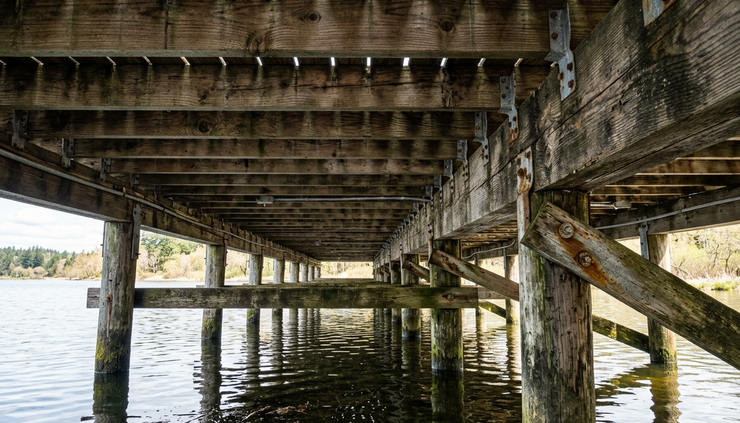
Use your feet, eyes, and hands. Walk slowly and feel for bounce. Look under the dock where possible. Check whether posts are plumb. Watch how the dock responds when a boat wake passes. During rain, notice where roof water actually goes.
Do not ignore repeated repairs. If the same railing, plank, brace, or fastener keeps failing, the visible problem may not be the true problem. Something below or behind it may be moving, holding water, or carrying too much load.
Professional inspections are helpful when a dock has a roof, boat lift, electrical service, major storm exposure, or signs of structural movement. A trained builder or engineer can trace loads and identify weak links that a surface check may miss.
The details decide how long a dock stays safe
A long-lasting dock is not built only from good decking and sturdy posts. It depends on the parts that keep the structure aligned, supported, dry, and connected. Blocking controls twisting. Bracing resists side movement. Roof framing carries weight and wind loads. Gutters and drainage move water away from vulnerable areas. Hardware, flashing, and utility details keep everything tied together without trapping moisture.
Neglecting these pieces can lead to familiar problems: sagging roofs, leaning posts, loose railings, springy decking, rusted connectors, rotten framing, unsafe ladders, and repairs that return year after year.
The best practice is to treat hidden details as part of the dock’s safety system, not as extras. Keep water moving away. Keep framing supported. Keep connections tight and corrosion-resistant. Watch for movement, and fix the cause instead of only replacing the visible damage.
A dock that performs well over time is usually not the one with the flashiest finish. It is the one where the unseen work was done right.


